Why Scan-to-BIM Investments Keep Going South
If you’ve been around owner-side capital projects or facilities long enough, you’ve probably seen this cycle before.
An owner funds a scan-to-BIM initiative, and it’s not cheap. A team comes in with laser scanners, captures the building, develops the Revit models, and delivers a clean set of drawings and documentation. For a time, everyone is excited because, for once, there is an accurate representation of what actually exists in the field.
Then reality starts happening.
A renovation happens on one floor. A vendor relocates equipment. A contractor shifts ductwork during a shutdown. Facilities make operational changes in the field that never make it back into the documentation set.
Individually, these are small changes. But they accumulate quickly. Industry research has found that up to 30% of a building’s elements differ from the original drawings shortly after construction is complete, before a single tenant has moved a workstation. Whatever was true at handover begins to drift on day one.
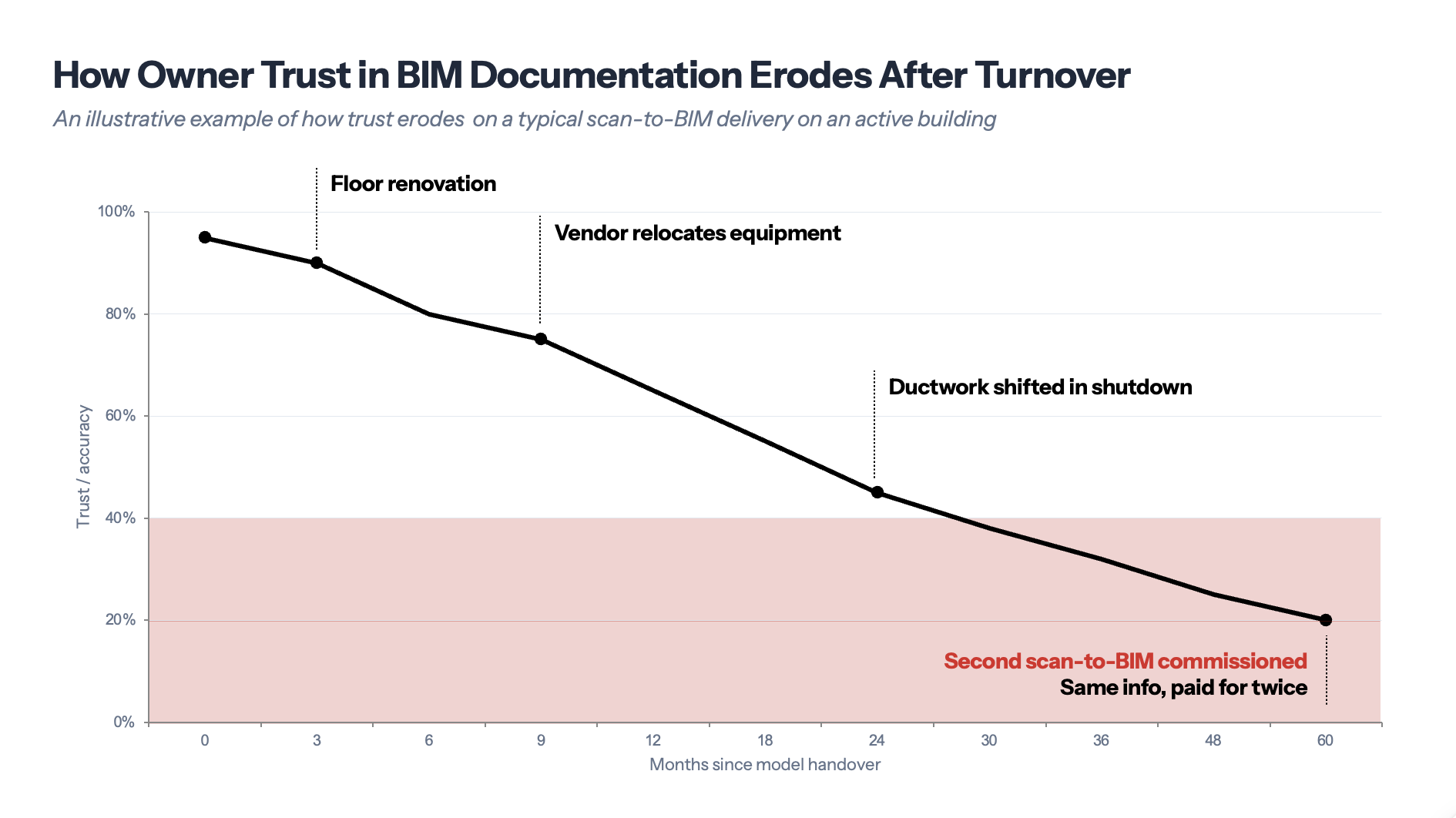
Six months later, teams begin questioning whether the drawings are fully up to date. A year later, people are walking the building again to verify conditions themselves. Eventually, the models become more of a reference point than something operations teams actually trust day to day.
Then a new capital project kicks off.
The project team needs existing conditions, looks at the old models, realizes they are no longer reliable enough for the next phase of work, and commissions another scan-to-BIM effort. Now the owner is funding another existing conditions project for information they technically already had.
The financial impact compounds beyond the rescan itself. Renovation projects working from inaccurate as-built documentation can add as much as 15–25% to project budgets in avoidable change orders, delays, and rework. At the industry level, FMI and Autodesk have estimated that poor data and miscommunication cost the U.S. construction industry roughly $177 billion annually, with “bad data” alone driving an estimated $88.69 billion in rework in (although these numbers are several years old, I suspect they’re still directionally accurate.)
I have seen versions of this play out across healthcare systems, corporate campuses, retail portfolios, life sciences, and large commercial environments. Usually, the original scan-to-BIM effort itself was not the issue. The issue was that nobody really planned for what happened after turnover.
Why owners still struggle to maintain accurate models
Usually, it is not because anybody failed. The incentives and workflows are just not set up to support the long-term maintenance of building documentation.
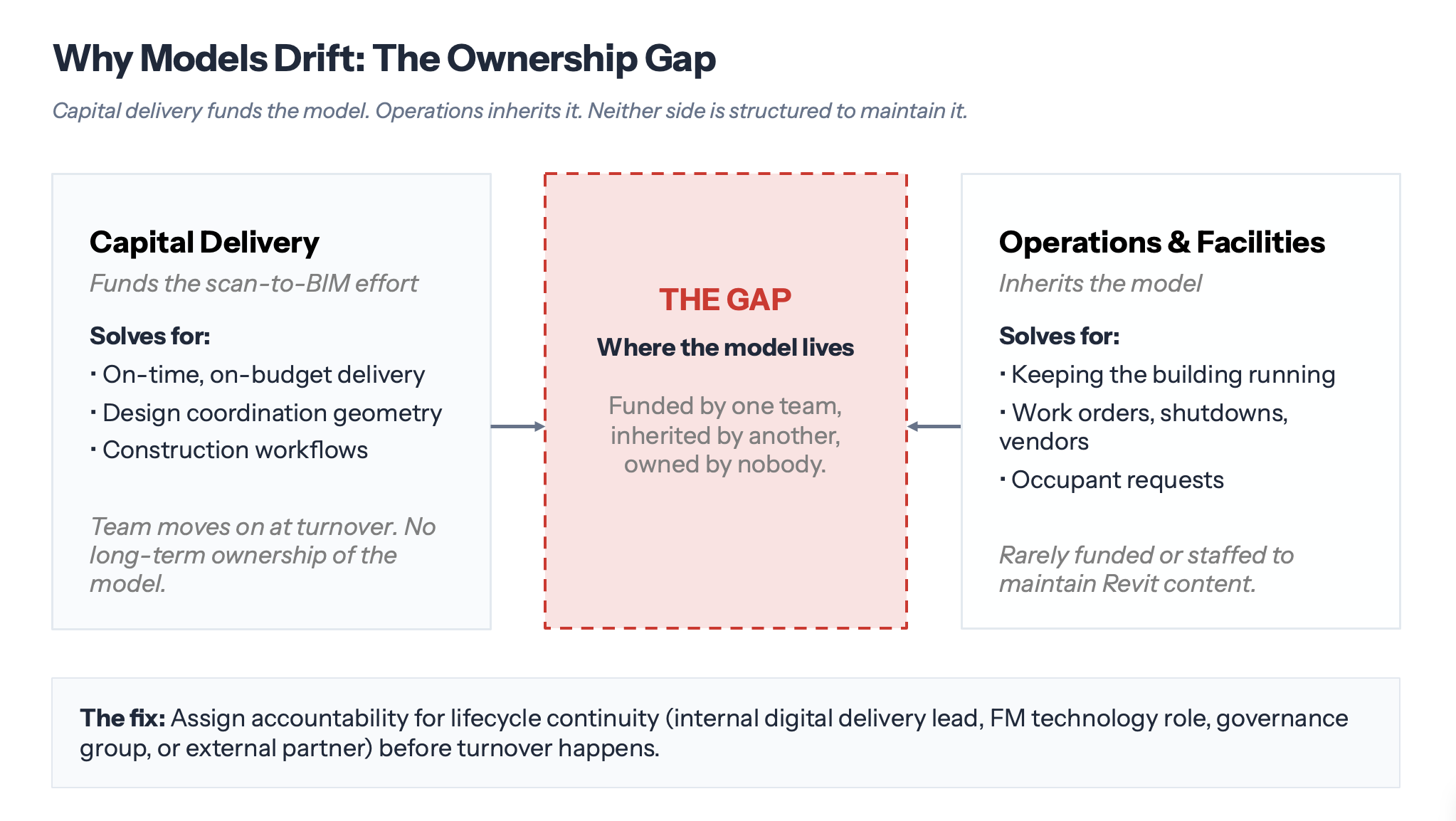
First, it is typically nobody’s actual responsibility.
Most facilities organizations are focused on keeping buildings operational. The people closest to the field reality are dealing with work orders, shutdowns, maintenance issues, vendor coordination, and occupant requests. Maintaining Revit models is usually not formally embedded in someone’s day-to-day role. As a result, documentation updates become something teams intend to get to later. In reality, later rarely comes.
Second, capital delivery and operations are solving for different things.
Capital project budgets are usually structured around delivering a project on schedule and within budget. Once construction is complete, the project team moves on. Meanwhile, the operations group inherits the deliverables, but often without dedicated budget, staffing, or workflows to maintain them long-term.
This is not a minor oversight. A 2018 study found roughly 80% of total building cost is incurred during the operational phase of the building lifecycle, not during design and construction. Yet most of the documentation effort, money, and attention still sits on the construction side of that curve. The models end up living in the gap between capital delivery and operations. One team funded them, another team inherited them, and neither side is structured to keep them aligned as conditions evolve.
Third, there is a knowledge gap and a usability issue that are not discussed enough.
Most facilities teams did not grow up working in Revit every day. Many still rely heavily on PDFs, 2D CAD backgrounds, or institutional knowledge from long-term staff. Meanwhile, project delivery teams are producing increasingly sophisticated BIM deliverables intended for design coordination and construction workflows. Often, those models are far more detailed than operations teams actually need.
The irony is that highly detailed design and construction models can sometimes become harder to maintain operationally. If someone only needs to understand room layouts, equipment locations, access constraints, and core asset information, handing over a highly complex federated model is not always helpful. The issue is not whether the model is “good.” The issue is whether it is maintainable and usable by the team inheriting it.
And training alone usually does not solve this either.
I have been involved in operational BIM training initiatives ranging from condensed workshops to longer-form Revit programs. What typically happens is facilities staff spend time learning the software, then return to their normal responsibilities and do not open Revit again for months. Without consistently using the platform, workflows and muscle memory do not stick. That is not a criticism of facilities teams. They are simply not operating in BIM environments for eight hours a day, as architecture and VDC teams are.
What owners should do differently?
Assign ownership.
Somebody needs responsibility and accountability for maintaining alignment between project delivery documentation and operational reality. Depending on the organization, that could be an internal digital delivery lead, a facilities technology role, a governance group, or an external partner supporting long-term standards and maintenance workflows. But somebody needs accountability for continuity across the lifecycle.
Be precise about what you are actually procuring.
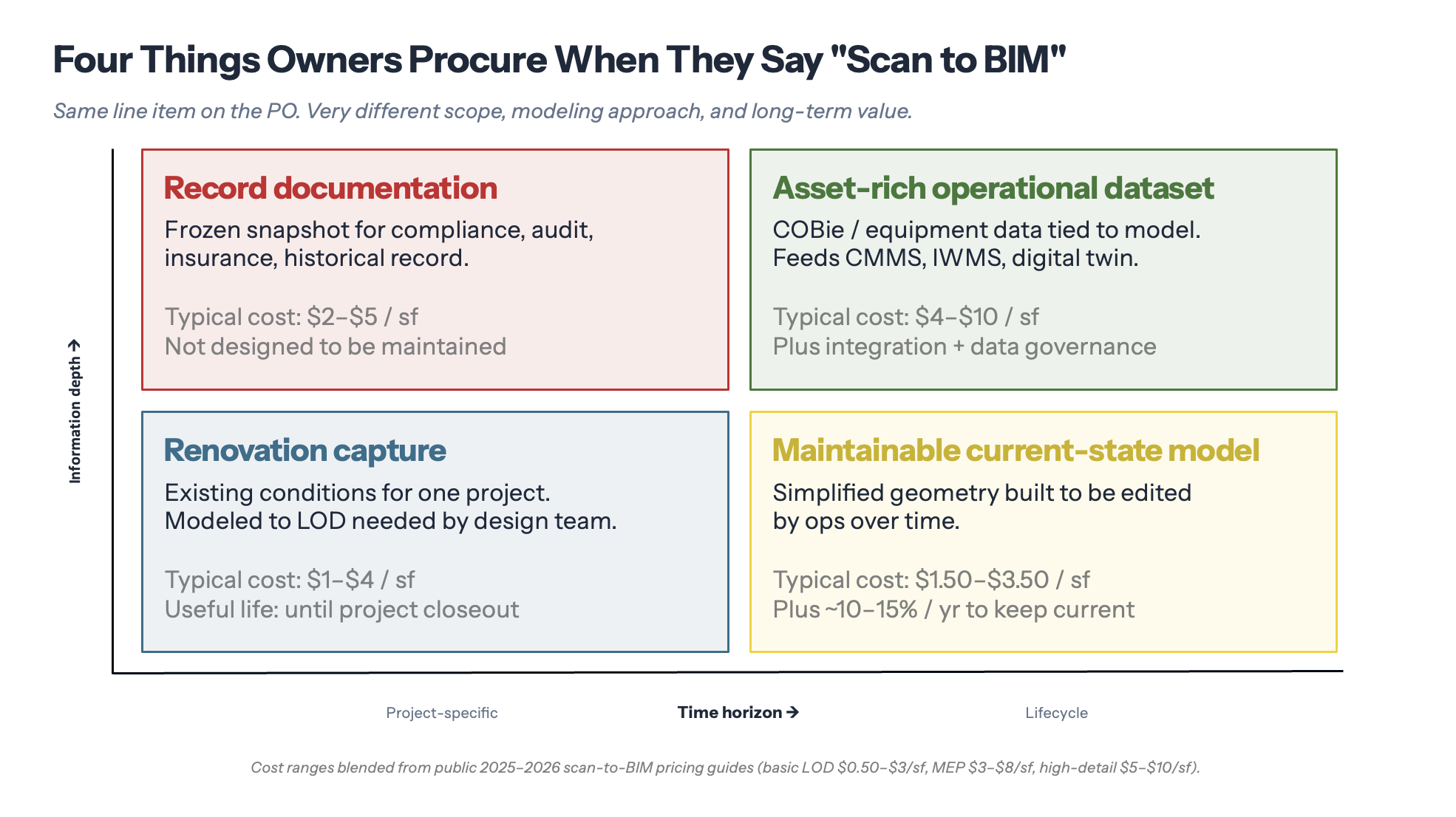
There is a major difference between:
- Capturing existing conditions for a specific renovation
- Developing long-term maintainable current-state models
- Producing record documentation for future operations
- Creating asset-rich operational datasets
Those are related efforts, but they are not the same thing. The scope, modeling approach, downstream workflows, and long-term value vary significantly depending on the actual operational objective. Public pricing guides list scan-to-BIM rates from $0.50 to $10 per square foot, and the difference is almost entirely driven by which of those scopes is actually being procured [6].
Specify deliverables with operations in mind, not just design and construction.
Most BIM deliverables are still optimized around project execution workflows because that is who is funding the effort. But if the long-term goal is operational use, that should influence how the models are structured before turnover even happens. When BIM is structured for operations, the returns are real.
In many cases, operations teams benefit more from simplified, maintainable models tied to reliable asset and drawing data than they do from highly detailed construction geometry that becomes difficult to update over time.
Be realistic about internal staffing and long-term maintenance expectations today.
The industry is moving in this direction, but most owner organizations are still building internal digital capabilities. The architecture, engineering, and construction side of the industry has largely standardized around BIM workflows. The owner-operator side is still catching up organizationally.
A 2022 IFMA survey found that roughly three-quarters of senior facilities leaders see value in digital twins, but only about 15% of real estate organizations have reached full production-stage adoption. The appetite is there. The operational capacity, in most cases, is not yet.
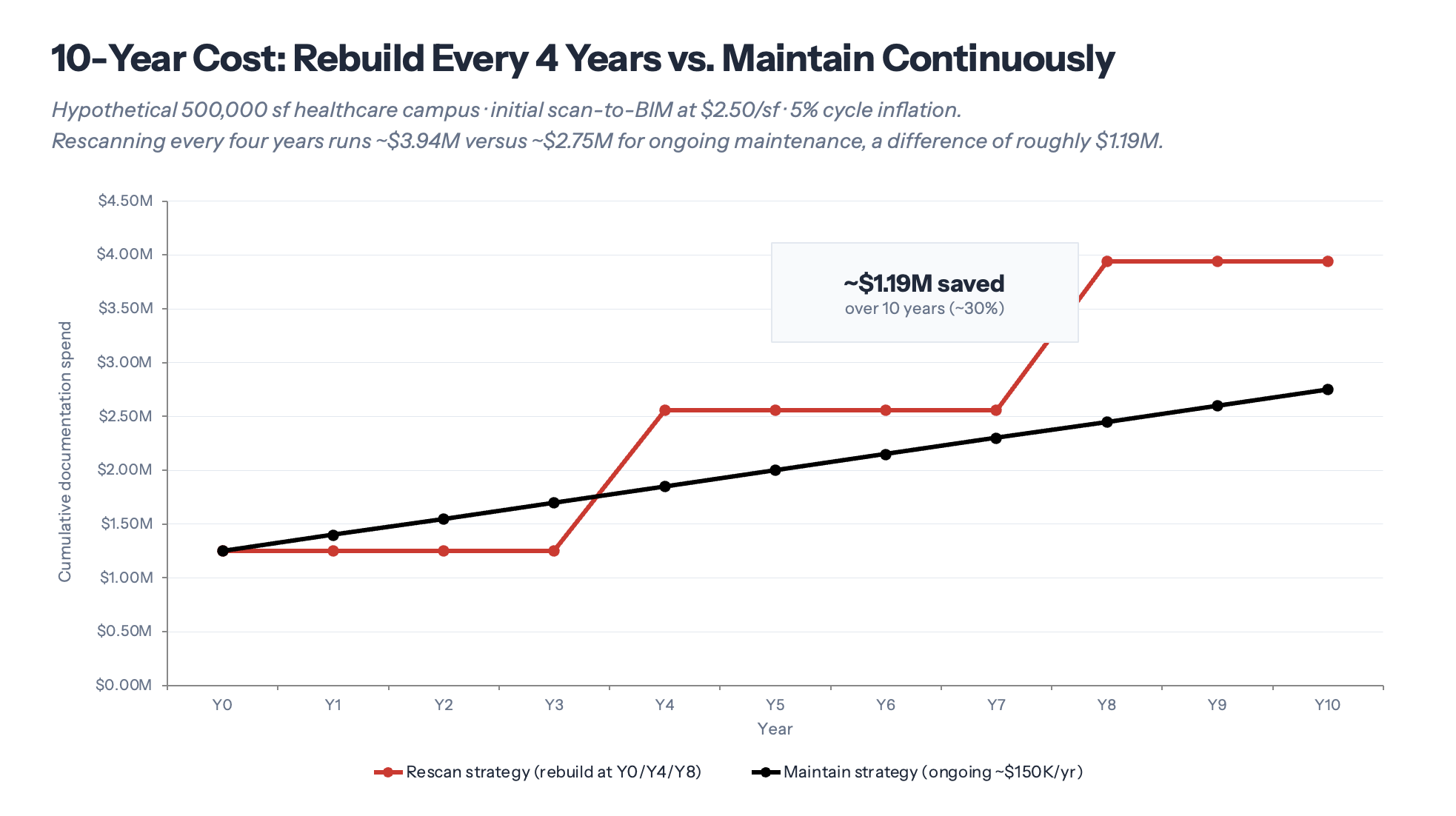
Right now, many owners are still better served by lightweight ongoing maintenance strategies than by repeating large-scale scan-to-BIM efforts every few years. That does not necessarily mean a massive outsourced engagement. Sometimes it simply means having a dedicated resource, internal or external, responsible for incorporating field changes into the documentation environment on an ongoing basis. The cost of maintaining usable documentation over time is usually far lower than repeatedly rebuilding existing conditions from scratch every time a new project begins.
Start with documentation that people trust
While the digital twin conversation continues to evolve, most organizations do not need to start with a fully integrated, highly sophisticated platform environment on day one. The first milestone is much simpler. Getting simple documentation that people can trust.
Have models and drawings that reflect field reality closely enough that teams actually rely on them during planning, shutdowns, renovations, and daily operations. Once that foundation is in place, organizations can mature into broader digital workflows over time.
I do think this problem will improve over the next decade. More owner organizations are building internal digital delivery teams. Younger professionals are entering facilities and operations environments with greater familiarity with BIM than previous generations. But most owners are operating buildings right now with documentation environments that are already drifting away from reality. Waiting for the talent pipeline to mature fully does not solve the immediate operational problem.
The organizations making the most progress today are usually those that treat building documentation as an ongoing operational process rather than a one-time project deliverable.
Because at the end of the day, the value of scan-to-BIM was never really the model itself. It was having information teams could trust when they needed to make decisions.


Key Accounts Manager
HOW WE HELP
BIM Services
Take your projects to new heights with the industry leader in BIM services, VIATechnik. Our solutions have been proven to radically enhance project efficiency, minimize risk, and maximize cost savings.