
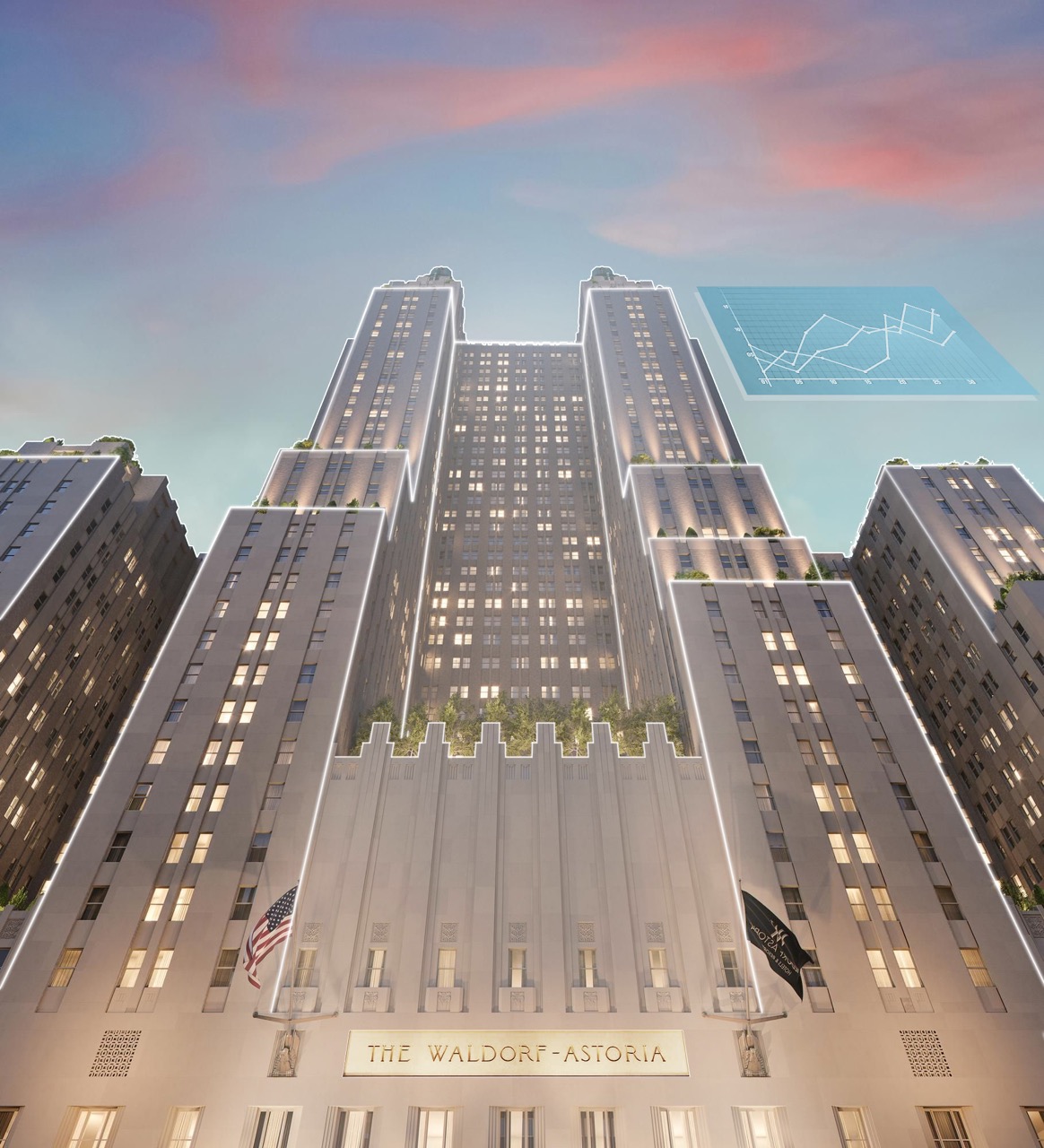
The Waldorf Astoria
A New Chapter for a Timeless Landmark
For nearly a century, the Waldorf Astoria has embodied New York’s elegance, serving as a symbol of sophistication where world leaders, celebrities, and visionaries once gathered beneath its glittering chandeliers. Behind the art deco glamour, however, the building’s aging infrastructure and outdated systems were struggling to meet the expectations of modern luxury.
In 2014, Chinese insurance giant Anbang Insurance Group purchased the Waldorf from Hilton for a record-setting $1.95 billion, at the time the highest price ever paid for a hotel in the United States. The vision was ambitious: transform the legendary property into a dual-function destination that would combine a five-star hotel with world-class private residences while preserving every inch of its historic architecture.
As plans took shape, the project quickly became defined by instability and upheaval. In 2017, Anbang’s founder was detained by the Chinese government, which led to a full government takeover of the company. Control of the Waldorf Astoria was transferred to Dajia Insurance Group, a newly formed state-run entity tasked with overseeing Anbang’s assets. The change in ownership brought new oversight, evolving priorities, and a fresh wave of uncertainty. The project’s original general contractor was dismissed, halting progress as new teams re-evaluated budgets, schedules, and coordination strategies.
By the time Suffolk was brought in to lead construction in 2017, the project had lost both momentum and direction. Known for managing some of the most technically demanding projects in the country, Suffolk was tasked with bringing structure and control back to a renovation that had grown increasingly complex. Suffolk and its Digital Engineering team quickly began re-establishing workflows, stabilizing budgets, and implementing its Plan + Control process to unify design, engineering, and field execution. Recognizing the scale of the coordination challenge ahead, Suffolk partnered with VIATechnik to strengthen digital collaboration and ensure every system, space, and sequence aligned before construction began. The vision remained bold, but with new leadership and renewed focus, the path forward finally began to take shape.

The Challenge: Rebuilding an Icon with Unreliable Data
From the outside, the Waldorf’s grandeur remained intact. Inside, it was a different story. Decades of hidden modifications and deteriorating materials had taken their toll. What began as a three-year renovation quickly became one of the most complex construction projects in the United States.
Hidden Conditions and Structural Surprises
Early in the process, Suffolk discovered that the structural engineer’s 3D model, based on drawings from the 1970s, did not match the reality inside the building. Measurements were off in places up to several feet, and the actual walls, slabs, and beams bore little resemblance to what the documents described.
One crew uncovered a steel beam drawn as one foot wide that actually measured three. Others found that partition walls contained cinder blocks, terracotta, and even chicken wire—materials dating back to the building’s original 1931 construction.
To make matters more difficult, an initial laser scan performed before Suffolk’s involvement produced poor-quality data that was misaligned and incomplete. Without accurate digital information, even basic coordination became risky and time-consuming.
Preserving History with Surgical Precision
Because the Waldorf Astoria is a designated New York City landmark, the project required the preservation or recreation of countless historic details. Every molding, light fixture, and column had to be documented, protected, and in many cases, rebuilt to exact specifications. In addition to the challenges with incomplete and outdated documentation, decades of unrecorded renovations had left the building’s structure inconsistent and unpredictable, adding another layer of complexity to every design and coordination effort.
This meant that every inch of construction had to fit perfectly. The smallest deviation risked damaging irreplaceable interiors or violating preservation requirements. The team had to modernize the building’s systems while maintaining the integrity of its original art deco craftsmanship.
A Project Under Extraordinary Pressure
External factors compounded the technical difficulties.
- Budget and Labor Pressures: Rising labor costs, union negotiations, and specialized restoration trades drove expenses far beyond early estimates.
- Leadership Instability: The transition from Anbang to Dajia Insurance Group introduced new leadership and oversight procedures, creating uncertainty during a period when consistent decision-making was critical to project progress.
- Pandemic Disruptions: The COVID-19 outbreak in early 2020 forced the closure of the project’s condominium sales gallery and slowed progress across all trades.
As deadlines slipped and costs climbed, Suffolk faced the challenge of rebuilding both the physical structure and the project’s momentum. What the team needed most was clarity—a way to see the true conditions of the building and a plan to align every stakeholder around a single, reliable source of truth.
The breakthrough came from returning to a disciplined Plan + Control process, aligning coordination to what mattered in the field. VIATechnik worked side-by-side with the Suffolk team and Digital Engineering to carry out that system with consistency and accountability.
The Solution: Clarity Through Coordination
When Suffolk took control of the Waldorf Astoria renovation, they introduced their innovative Plan + Control methodology — a process designed to merge design intent, construction data, and scheduling into one cohesive digital environment. The system allows teams to anticipate issues before they occur, visualize installation sequencing, and minimize rework on site.
But technology alone cannot solve complex problems. It needs a partner who understands how to translate information into action and maintain consistent, transparent communication across every team. This is where VIATechnik worked alongside Suffolk to enhance the Plan + Control process, helping the team stay coordinated and focused on the project’s demanding requirements.
Becoming the Linchpin Between Teams
Suffolk’s success with Plan + Control depended on precise, continuous coordination across several disciplines — architecture, structure, mechanical, electrical, plumbing, life safety, and interior finishes — all of which had to fit within landmark constraints.
VIATechnik’s deep experience with Suffolk’s Plan + Control process and its track record of managing complex coordination on large-scale projects positioned the team to elevate the system to its fullest potential at the Waldorf Astoria. As the project evolved and the scope of work became increasingly intricate, VIATechnik’s partnership helped push Plan + Control into a higher gear—turning it from a digital coordination framework into a dynamic, real-time management tool. Serving as the linchpin between Suffolk’s field team, design team, and Plan + Control coordination group, VIATechnik ensured that information flowed seamlessly between the model environment and the physical construction effort, keeping every discipline aligned and every decision grounded in accurate, up-to-date information. VIATechnik became the connective tissue that held the process together. The team worked directly with the general contractor, engineers, and trade partners to identify conflicts, communicate design issues, and confirm approved routing before shop drawings were finalized.

Guiding the Process, Not Recreating It
Unlike other projects where modeling and scanning might fall under VIATechnik’s scope, at the Waldorf Astoria the firm’s role was purely strategic coordination. Rather than performing scanning or creating models, the team guided the integration between Suffolk’s Plan + Control process and the project’s design and construction teams.
VIATechnik’s value came from:
- Ensuring that the high-end finishes of the historic building were maintained from the design phase to reality.
- Interpreting complex BIM coordination data and helping each trade understand what adjustments were needed in the field.
- Facilitating issue resolution between the Plan + Control team and external design consultants.
- Ensuring compliance with New York City building codes, historic preservation standards, and architectural intent.
- Maintaining progress and accountability by translating digital discoveries into actionable field solutions.
This proactive, communication-driven role prevented the project from falling into the trap of reactive problem-solving that often plagues large restorations. Instead, the digital coordination effort became a true management tool that informed decision-making, sequencing, and design revisions.
Turning Technology into a Common Language
The Waldorf Astoria renovation was divided into three major work streams: hotel, residential, and core & shell infrastructure. Each had its own unique set of challenges, subcontractors, and design priorities. The sheer volume of information being shared daily created constant potential for misalignment.
Through disciplined communication and structured coordination sessions, VIATechnik helped translate the output of Suffolk’s Plan + Control environment into clear direction for all stakeholders.
VIATechnik’s focus was not on the technology itself, but on how Suffolk’s teams used it. The VIATechnik team made sure that each coordination issue discovered digitally was resolved collaboratively and verified physically. By maintaining this bridge between the digital and real-world construction environments, VIATechnik ensured that Plan + Control achieved what it was designed to do; prevent problems before they reached the field. Through tools such as the 3D scanning and weekly OpenSpace walks, the VIATechnik team was able to work side by side with the Suffolk team whether we were on-site with them or across the country assisting digitally.
Results and Impact: Restoring Clarity, Control, and Confidence
After years of uncertainty and disruption, the Waldorf Astoria project finally found its rhythm. The coordination and communication systems that VIATechnik helped implement gave Suffolk’s team the clarity and structure they needed to move forward with confidence.
What had once been a fragmented effort became a coordinated, intelligent process. Problems that previously took weeks to surface were now identified, discussed, and resolved in days. Instead of reacting to new discoveries, Suffolk’s teams were able to anticipate them.
Rebuilding Momentum on a Stalled Project
When Suffolk took over as general contractor, the project was already years behind schedule and millions of dollars over budget. The early coordination issues — stemming from inaccurate drawings, incomplete scans, and inconsistent communication eroded confidence and stalled progress.
Through its role as the digital coordination leader, VIATechnik helped reestablish momentum by ensuring that Suffolk’s Plan + Control process was not just operational, but effective. Each team now had a clear understanding of how their work fit within the larger plan. Conflicts that once stopped field crews could now be addressed digitally and resolved before reaching the job site.
The result was a more predictable, measurable, and accountable workflow.

Preventing Rework and Preserving Heritage Spaces
The Waldorf’s intricate interiors and tight tolerances left no room for field improvisation. Even a small installation error could have damaged irreplaceable finishes or delayed other trades.
By integrating digital coordination into daily decision-making, Suffolk was able to uncover and resolve tens of thousands of issues before they ever reached the field. Another powerful outcome of this process was the data it produced, measurable metrics that demonstrated the effectiveness of disciplined coordination and set a new standard for project transparency.
These results illustrate the true impact of proactive coordination. Nearly 30,000 potential conflicts were identified and addressed digitally, reducing costly field rework and keeping the historic restoration on track. For the residences alone, only 126 RFIs were generated from coordination back to the design teams (On a project of this magnitude it would not be uncommon to have several thousand!). In construction, each RFI (Request for Information) represents a clarification sent from the field to designers or engineers to resolve a conflict or ambiguity. Reducing that volume so dramatically meant fewer disruptions, faster decision-making, and greater confidence that the work being executed in the field matched design intent.

Each clash resolved in the model represented time, labor, and resources saved in the field. More importantly, it validated the core principle behind Suffolk’s Plan + Control process: that careful preparation and disciplined communication create predictability, even in the most intricate environments.
- Fewer RFIs and change orders related to coordination issues.
- Shorter lead times for approvals and re-routing decisions.
- Reduced risk of field rework that could jeopardize historic preservation.
Each issue resolved upstream protected the project from potential setbacks downstream — a critical outcome for a restoration where every inch and every dollar mattered.
Delivering Predictability in an Unpredictable Environment
Between ownership transitions, regulatory hurdles, and pandemic disruptions, few large projects have faced the level of volatility seen at the Waldorf Astoria. Yet through disciplined coordination and transparent communication, Suffolk regained control of a project that had once seemed unmanageable.
By the time the hotel and residences began reopening in 2025, the value of coordination was unmistakable. Suffolk’s Plan + Control system, supported and reinforced by VIATechnik’s digital leadership, had become the backbone of project execution. It not only reduced further overruns but provided a framework for smarter decision-making that extended to design revisions, procurement, and scheduling.
In measurable terms, VIATechnik’s coordination leadership contributed to:
- Thousands of field conflicts avoided across the 47 stories through early identification in digital coordination sessions.
- Significant time savings on MEP layout and sequencing, reducing costly rework.
- Improved cross-discipline alignment, particularly between architectural teams and modern building systems.
- Renewed stakeholder confidence, allowing construction to progress with shared accountability and trust in the model.
From Fragmentation to Focus
Perhaps the most meaningful result was cultural rather than technical. By helping Suffolk apply the Plan + Control process with consistency and purpose, VIATechnik turned it into a practical way of working each day. Coordination became a disciplined routine, with six structured meetings held each week, typically lasting about an hour and a half, supported by additional spin-off sessions for detailed system reviews. These regular touchpoints kept communication constant and progress measurable. Every trade and discipline stayed aligned on updates, design adjustments, and upcoming field activities. Through this cadence, a once-fragmented team began to operate as one. Designers, engineers, and subcontractors shifted from reacting to problems to collaborating around shared goals.
The difference was not in the technology itself but in how it was used. VIATechnik’s coordination leadership transformed digital data into a common language that everyone could understand — from the modeling team to the trades installing systems in the field.
Through that alignment, Suffolk was able to turn one of New York’s most complicated restorations into a story of persistence, precision, and partnership.
Key Takeaways: Turning Complexity into Clarity
The Waldorf Astoria project stands as a testament to what can be achieved when technology, communication, and trust come together around a shared purpose. While the renovation demanded world-class engineering and precision, the deeper success came from alignment—between vision, process, and people.
1. Leadership Drove the Vision: Suffolk led one of the most ambitious restoration efforts in New York’s history. The company’s commitment to quality, safety, and heritage preservation drove the project forward, even as external challenges mounted. VIATechnik’s role was to serve as a trusted guide, helping Suffolk’s teams communicate, coordinate, and stay focused on what mattered most: delivering excellence.
2. Collaboration Is the True Foundation of Progress: Every project faces technical hurdles, but on the Waldorf Astoria, the difference between success and failure came down to collaboration. By reinforcing Suffolk’s Plan + Control process and ensuring consistent collaboration, VIATechnik helped the team anticipate conflicts instead of reacting to them. Clear communication became as valuable as any physical material on the job.
3. Clarity Builds Confidence: Projects of this scale succeed when everyone sees the same picture. VIATechnik helped translate digital coordination data into understandable, actionable insight for every trade partner and stakeholder. This shared clarity restored confidence across the project and gave leadership the information they needed to make timely, informed decisions.
4. Partnership Over Production: VIATechnik’s success was not measured in deliverables, but in outcomes. By serving as a proactive coordination partner rather than a task-based consultant, the VIATechnik team helped Suffolk maintain control over one of the most complex projects in the city. True value came from collaboration, transparency, and problem-solving that moved the entire project team forward.
5. Validation for Suffolk’s Plan + Control Process: The Waldorf Astoria proved that Suffolk’s Plan + Control process is not just a concept but a proven method for managing complex construction. By building the model directly from the design drawings and identifying issues before work began, the team embodied the “measure twice, cut once” philosophy. The success of this project demonstrated how a disciplined approach to coordination can reduce risk, improve predictability, and strengthen collaboration across every phase of construction. What worked at the Waldorf can now serve as a model for projects of any size or complexity.

Additional Metrics to consider
1. Time Savings Estimate
Industry Baseline: According to McGraw Hill’s SmartMarket Report on BIM for Construction (2020),
- Early clash detection can reduce rework-related delay by 5–15% of total schedule time,
- and shorten coordination cycles by 25–40%.
Application to Waldorf Data:
With 30,000 issues resolved digitally, assume even a modest 5% schedule efficiency gain on an 8-year (96-month) renovation timeline:
96 months × 5% = ≈ 4.8 months saved
You could conservatively state:
“Benchmark data suggests that resolving issues digitally rather than in the field likely saved 4 to 6 months of cumulative schedule impact across all scopes.”
2. Cost Savings from Reduced Rework
Industry Baseline: NIBS and Dodge Data studies consistently report that
- Rework accounts for 5–15% of total construction cost,
- BIM coordination can reduce that rework by 30–50%.
Typical savings: 1–3% of total project cost.
Application to Waldorf (approx. $6B total development): If BIM coordination avoided even 1% of potential rework cost: $6,000,000,000 × 1% = $60,000,000 saved
A realistic published range would be: “Based on industry benchmarks, the coordination process may have prevented between $60 and $120 million in potential rework and change order costs.”
3. Efficiency Measured by RFIs
Industry Baseline: Traditional large-scale projects average one RFI per 4–6 coordination issues,
whereas mature BIM coordination efforts often achieve ratios of 1 per 100+ issues.
Your Data: Residences: 21,617 issues → 126 RFIs
That’s roughly 1 RFI per 171 coordination issues.
This ratio indicates a 70–80% reduction in coordination-related RFIs compared to the industry norm.
You can confidently phrase this as: “For every 170 issues identified digitally, only one required field clarification, representing a 70–80% reduction in coordination-related RFIs compared to industry averages.”

We would love to learn more about your needs and discuss how we can partner to advance your project and enterprise outcomes. Let's talk!
Contact Us