The Digital Twin Maturity Model: Just start already
You’ve probably heard the digital twin pitch by now.
You know the market is growing fast (from about $24 billion in 2025 to an estimated $260 billion by 2032.) You’ve heard about the studies from folks like McKinsey, claiming implementations can deliver 20-30% improvements in capital and operational efficiency.
And yet, like a surprising number of hospital administrators, data center operators, and retail facility managers, you’ve sat this one out so far. Not because you’re skeptical. But because you’ve been sold a lie about what a digital twin actually requires.
The typical pitch makes digital twins sound like massive, enterprise-wide transformations. That need perfect data. Massive budgets. Buy-in from every stakeholder in the building.
That pitch creates paralysis, understandably. Everyone waits for that “right” moment that never comes. Meanwhile, your facility managers are still hunting through file cabinets for equipment manuals.
If this sounds like your organization, I have wonderful news. A digital twin doesn’t have to be complicated. You can start with what you have, solve one real problem, and build from there.
The Digital Twin Maturity Model gives you a mental model for how to do that (and how to get your team on board).
A quick alignment on definitions.
Before we go any further, let’s simplify what we mean by a digital twin.
A digital twin is simply a way to organize information about a physical building so teams can make better decisions. It brings together existing drawings, asset data, and operational information in one place and connects that information to the physical space. Over time, it can incorporate live data and analytics, but it doesn’t have to start there.
You’ll hear digital twins described in many ways. For this article, it’s enough to know that a twin isn’t just a 3D model or a dashboard, and it doesn’t require new construction. It’s something you can build gradually, using whatever data you already have.
And (this is the one that confused folks the most) digital twins are NOT only for new construction. You can build one for an existing building, at any point in its lifecycle.
The biggest misconception: you need to have everything right to start.
There is a principle around the conventional thinking with digital twins that is partially true. A digital twin is only as useful as the data feeding it. A twin with no data doesn’t do much.
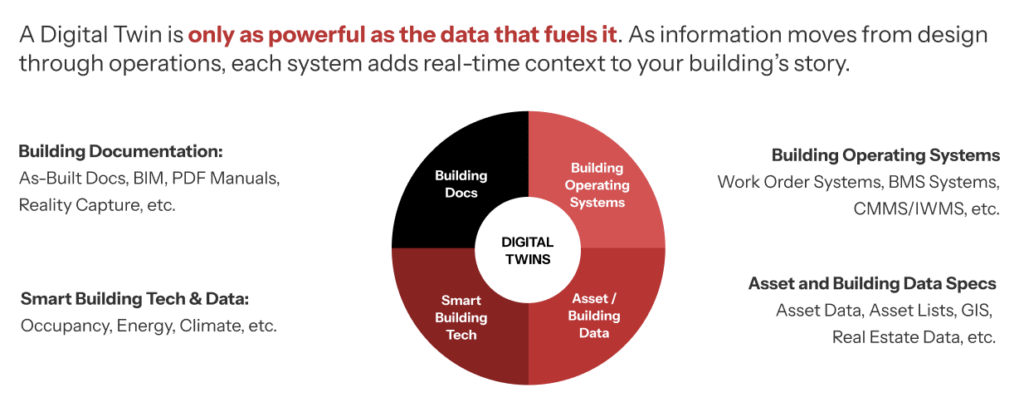
But a fully baked solution that is only half true is a dangerous thing. Yes you need data. But you don’t need all the data all at once. You just need enough to solve a problem worth solving.
The problem with thinking you need perfect data conditions to start is that you’ll never get there. Your data will probably always be at least somewhat messy. The “perfect” platform will never arrive. And the likelihood you’ll get the budget for the massive overhaul all at once is possible, but slim.
And every day without a digital twin is a day facility managers waste time searching for documentation. A day maintenance responds to problems after they happen instead of before. A day capital planning gets done with guesswork vs. data. A day compliance management is harder than it needs to be.
You don’t need to wait. You need to start small.
The five stages of digital twin maturity
Our Digital Twin Maturity Model breaks the journey into five stages. Each one delivers real value on its own. You don’t need to reach Stage 5 to see ROI. You don’t need perfect data to begin. You just need to start. Here’s how:
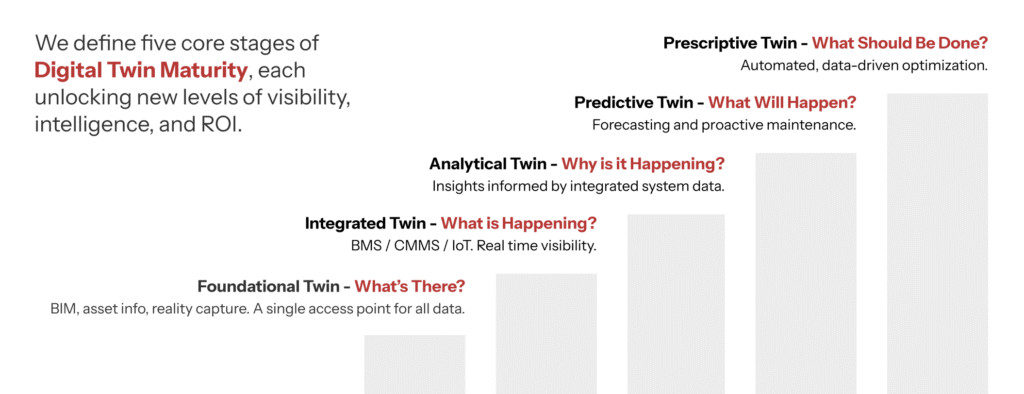
Stage 1: Foundational Twin – “What’s there?”
This stage answers the basics. What assets, systems, and spaces exist in my building?
A Foundational Twin establishes a clear, spatially organized view of what assets exist in a building and where they are located. It consolidates as-built drawings, equipment lists, manuals, and reality capture into a single access point that lets facility managers identify assets, understand their context, and find supporting documentation quickly.
At this stage, the twin functions as an asset inventory tied to physical location, not just a document repository. Facility teams can see what they own, where it is, and what information exists for each asset.
Sounds simple, but it gives you value immediately.
- Facility managers know what assets they have and exactly where they are located, reducing time spent hunting for equipment or documentation.
- Owners receive a structured asset handover instead of fragmented files.
- Renovation teams can see asset locations behind walls before construction begins.
How to start:
Centralize what you already have. You likely already have as-built drawings, equipment manuals, photos, and asset data spread across systems and folders.
The first step is linking this information into a centralized access point. That that’s a software platform, a 3D model, or both.
If you want a 3D model but don’t have one, laser scanning and scan to BIM services can create one quickly. Or you can leverage the laser scan on its own for a 3D walkthrough.
You don’t need BIM to get started, but a BIM-enabled digital twin can enhance visualization and spatial context as your program matures.
Stage 2: Integrated Twin – “What’s happening?”
Stage 2 builds directly on this asset foundation by connecting those identified assets to real-time operational data. You connect building management systems, CMMS, IoT sensors, and other live data sources to see what’s happening right now.
What you get:
- Facility teams see the current status of all systems in one interface instead of toggling between multiple dashboards (or walking the building.)
- When an alert triggers (a temperature deviation in a data center, a malfunctioning HVAC unit in a hospital) technicians can locate the affected equipment in the 3D model and respond faster.
- During capital projects, construction teams can see which systems are active and which areas are occupied.
How to start:
Find the systems that are most critical to your operations that already generate data. For a data center that’s probably cooling and power distribution. For a hospital it might be life safety systems or environmental controls.
Connect one or two systems to your Foundational Twin. You don’t have to overhaul your technology stack. You can layer these things in sequentially.
Stage 3: Analytical Twin – “Why is it happening?”
This stage is when things start to get fun. You can incorporates analytics, machine learning, and AI to interpret data and identify causal relationships from historical BMS data, your IoT sensors, even external data like weather patterns or occupancy trends.
What you get:
- When a problem occurs, the digital twin looks at historical data to find the underlying cause rather than treating symptoms.
- By understanding why certain systems consume more energy or require more maintenance, teams can make targeted improvements to improve operations.
- When planning upgrades, owners can prioritize investments based on actual performance data.
How to start:
Look for recurring operational challenges. If certain equipment requires frequent maintenance, analyze historical work orders, sensor data, and environmental conditions to find patterns. (This stage obviously benefits from partnering with someone who has data analytics and machine learning expertise.)
Stage 4: Predictive Twin – “What will happen?”
This stage uses real-time feedback, machine learning models, and simulation to forecast future conditions. Your digital twin becomes a tool for proactive decision-making. Equipment failures before they happen. Forecasting energy demand. Simulating the impact of proposed changes before implementing them.
At this stage, predictive insights also begin to inform total cost of ownership decisions, helping owners weigh continued maintenance against replacement or upgrade scenarios.
What you get:
- Enhanced predictive maintenance. Instead of responding to failures or following fixed maintenance schedules, teams use fault-detection data within a digital twin context to visualize conditions spatially and intervene when equipment is likely to fail—reducing downtime and extending asset life.
- For hospitals and data centers, the ability to predict and prevent failures isn’t just about cost savings; it’s about operational continuity and safety.
- Before making major capital investments, owners can compare projected maintenance costs, energy consumption, and failure risk against replacement scenarios, enabling more informed total cost of ownership decisions.
How to start:
Focus on high-value, high-risk assets where failure has serious consequences and where long-term maintenance costs materially impact capital planning decisions.
For a hospital you’re most likely looking at backup generators, HVAC serving operating rooms. A data center might look at their cooling infrastructure or power distribution units.
Implement predictive maintenance for these assets first, using historical failure data and real-time sensor inputs
Stage 5: Prescriptive Twin – “What should be done?”
This is the most advanced stage. The digital twin doesn’t just predict what will happen, it recommends (or even automates) the optimal response.
Data feeds into a learning environment where the twin continuously improves its recommendations. In some cases, the twin adjusts building systems autonomously.
What you get:
- Building systems automatically adjust to optimize energy efficiency, occupant comfort, and operational performance.
- The system learns and improves continuously, operating the building at peak efficiency with minimal human intervention.
How to start:
This stage represents where the industry is heading. But most organizations aren’t here yet, and that’s normal.
Prescriptive twins require years of accumulated data, trust in analytics, and operational maturity. They’re not something you “turn on.” They emerge after teams have already proven value with foundational, integrated, and analytical twins.
Organizations typically won’t reach stage 5 for years. Which is fine! Real ROI begins at Stages 1 through 3.
Think of Stage 5 as an aspirational goal, not a prerequisite for starting.
Each stage builds on the last.
- Stage 1 provides a single source of truth.
- Stage 2 adds real-time visibility.
- Stage 3 explains why problems occur.
- Stage 4 predicts future issues.
- Stage 5 automates optimal responses.
The data collected at Stage 1 fuels the analytics at Stage 3. The insights from Stage 3 inform the predictive models at Stage 4.
The maturity model also makes it easier to get internal buy-in. You need approval from IT, operations, facilities, and executive leadership. Instead of asking for a massive upfront investment in an abstract concept, you can present a phased plan with clear ROI at each step. That’s a much easier conversation.
You’re more ready than you think.
You don’t need perfect data. You don’t need the perfectly integrated platform. You don’t need enterprise-wide buy-in. You need a specific problem to solve, and the willingness to take the first step. A few recommendations for getting started.
Identify ONE problem.
Pick a tangible pain point that’s costing you time, money, or efficiency. Ask questions like:
- “How do we keep compliance documentation for life safety systems accurate and accessible during inspections?”
- “How do we reduce the time technicians spend locating equipment for maintenance?”
- “How do we streamline multi-store renovation planning?”
Look at your existing data.
You probably have more than you realize. BIM models or CAD drawings. As-built documentation and equipment manuals. Photos from site walks. Asset lists from your CMMS. Sensor data from building management systems.
Even if this data is fragmented or stored in different formats, it’s a starting point.
Start at Stage 1.
Aim for a Foundational Twin focused on a specific scope – a single building, a single floor, or a single critical system. Create a single source of truth that consolidates existing documentation and links it to a 3D spatial model. If you don’t have a 3D model, reality capture can provide a point-cloud-based 3D walkthrough on its own, or serve as the foundation for scan-to-BIM if a model is needed later.
Build momentum.
Once you’ve demonstrated value by solving one problem, expand. Add more buildings or systems. Stitch in real-time data. Use the insights you gain to identify the next problem worth solving. Think of this as a series of small wins rather than a single transformation.
Get started
The perception that digital twins require perfection before you can begin is wrong, and it’s expensive. Every day you wait is a day of lost value.
The Digital Twin Maturity Model offers a different way to think about it: not as a destination, but as a journey you can start today with whatever data you have.
You don’t need permission. You don’t need a massive budget. You just need to start.
Ready to figure out your first step?
VIATechnik can help you assess your readiness and build a roadmap that fits your actual situation. Visit viatechnik.com/contact-us to book a call.


VDC Project Director

Vice President, Real Estate and Facilities Owners
HOW WE HELP
Digital Twin
Embark on a journey into the future of innovation with VIATechnik's digital twin consulting services. The full potential of digital twin technology is realized when it evolves from simply replicating your physical assets to providing predictive analysis, increased efficiency, and data-driven decision-making. VIATechnik is your trusted partner on this transformative path to utilizing digital twins.